
Globe Busted Record Custodians
Globe is the Gila County seat and runs its own police force. That splits any arrest into three custodies. Globe Police keeps municipal incident reports and the media its officers produce. The sheriff's office takes over when a person enters county detention. It holds the intake logs, custody details, and booking photos. The court keeps the filings and the final word on the case. Treat the three as separate stages, not one merged arrest file.
The department works around the clock through two divisions. Administrative Services covers records and dispatch. Operations handles patrol and investigations. A city arrest often leads to county detention, but nothing guarantees where a person gets booked or held. Placement depends on classification, jail capacity, medical needs, transfers, and court schedule.
Globe Arrests Have No Blotter
Want a daily arrest log or mugshot feed from Globe Police? None exists online. The city's Documents, Forms, and News sections publish no booking list, no blotter, and no photo gallery. So there is no standard field list, archive window, posting schedule, or photo policy to lean on. A quiet city news page proves nothing about whether arrests happened.
The official Globe Police page is the city source for the department's structure and contact information:
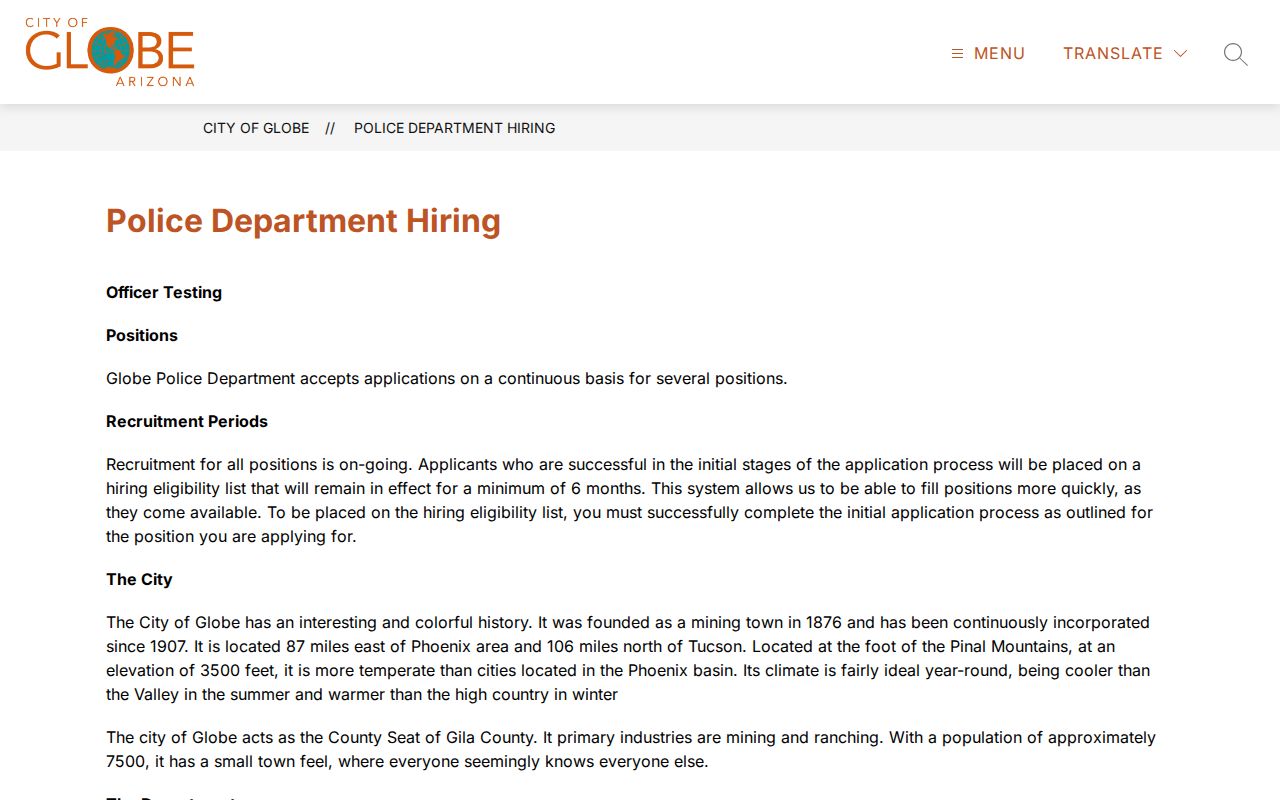
That page confirms the agency exists and how to reach it. It is not an arrest search, though. For police records, ask for Administrative Services directly.
Globe also has a general city app covering news, events, documents, and alerts. The city never markets it as an inmate locator or mugshot tool. GCSO News is selective too. Neither one replaces a custody phone call or a formal records request.
Note: The missing blotter reflects how records get published, not whether Arizona law lets you request them.
Find Globe Busted Mugshots
Start with official sources. Each one has a defined job. Each answers a different piece of the question. Independent news can add context around an incident, yet it will never confirm a full booking history. Commercial mugshot indexes are weakest of all for Gila County.
| Channel | Photo? | Authority | What it answers |
|---|---|---|---|
| Globe Police | By request if held | Official city agency | Municipal report and police-held material |
| GCSO jail phone | No promised photo | Official county agency | Current custody or release status |
| GCSO Records | Request specifically | Official county agency | Booking sheet, adult arrest record, and booking photograph |
| Arizona courts | Not a photo channel | Official judiciary | Filed case and disposition |
| Globe local news | Sometimes | Independent, selective | Reported incidents and public-safety context |
| Commercial indexes | Sparse or absent | Unofficial | No reliable current Globe booking coverage |
Check the big commercial sites and you will come up empty. RecentlyBooked, Arrests.org, Busted Newspaper, and Mugshots.zone have no verified Gila section. Mugshots.com carries only a small historical Gila collection. It cannot be filtered reliably by city either. Read those gaps as a warning about the sites, not as proof that a named person was never booked. A commercial page can also sit stale for years, detached from whatever the court later decided.
Globe Arrest and Mugshot Lookup
The smart Globe search follows the record from event to outcome. The county posts no verified web roster. There is no same-day, 48-hour, 72-hour, or weekly booking feed either. So start with a phone call for live custody, then move to written requests for paper documents. The Gila County booking and custody guide covers that countywide route in depth.
- For a recent municipal event, note the person's full name, event date, Globe location, and Globe Police report number when known.
- Call Globe inmate information at 928-402-8666 for current county custody. If placement or transfer is uncertain, also call Payson at 928-468-2835.
- Ask Globe Police Administrative Services for the city incident report and any specifically identified police-held image.
- Use the GCSO Records Request Center for the booking sheet and booking photograph, naming Globe Police as the arresting agency.
- Search Arizona Public Access and confirm the final result with the court that handled the case.
Not every arrest ends in a jail stay. A citation and release can skip county detention entirely. Someone can also leave a roster's present-tense view through release, a transfer, or a state-prison commitment. For sentenced Arizona prisoners, ADCRR is the agency to query, not the source for a fresh Globe arrest. Picking the source that matches the custody status keeps you from reading an empty result as proof that nothing happened.
Globe Police Arrest Records
Globe posts a police contact form. Beyond that, the city offers no separate records-request form, records line, fee schedule, or turnaround promise. Call the main number and ask for Administrative Services or Records. Before sending anything sensitive, confirm the submission method, required identifiers, possible redactions, cost estimate, and delivery format.
Globe Police Department
175 N. Pine Street
Globe, AZ 85501
Main phone: 928-425-5751
Operations run 24/7. Ask Administrative Services for the current records process.
File the police report and the county booking material as two separate requests. A solid city request names the person, gives the date and place of the incident, and includes a report number if you have one. State exactly what you want, too. For the jail photograph, GCSO Records is the custodian. Its fee schedule lists adult arrest records, photos, and flash drives, but no single flat fee covers every photo request. Ask the Records Division to quote yours.
Note: A police contact reply is not a jail custody check, and a jail call will not produce the municipal report.
Globe Booking and Photo Timing
GCSO treats booking and classification as two separate jail functions. State law also demands an initial appearance within a day, or release. Neither point creates a fixed timeline from photo to web. In fact, Gila County posts no public booking roster, so no official display schedule exists to check. A booking image is an agency-held record. Your records request should say so plainly.
How long does a report take? GCSO points to roughly ten working days after a request, with some stretching past fourteen. The incident or investigation drives that spread. That clock applies to reports, not photos. Review time, redaction, sealed files, juvenile rules, victim privacy, and open investigations can each change what gets released.
- Incident report
- The arresting agency's account of the investigated event.
- Booking record
- The county jail intake record, including charges as entered and custody details.
- Disposition
- The court's later resolution, which may not match the first charge.
Charges listed at booking can change or vanish later. In Globe that distinction matters, since city, county, and court offices sit close together yet answer to different laws and different jobs.
Globe Busted News Archives
The Arizona Silver Belt once ran weekly "Arrest Reports" sorted by agency. It covered GCSO, DPS, Globe Police, and others. A typical issue carried names, ages, localities, charges, and arresting agencies. Publication stopped in August 2025. Old issues still work as archival leads, but they cannot tell you who was busted in Globe this week.
For current coverage, turn to living outlets. Globe-Miami Times offers strong local policy and public-safety reporting, while Globe & Miami Gazette tracks city and police news. KAFF News adds regional Gila coverage. None promises a full booking ledger or a standard mugshot practice. The county's Crime News & Mugshots page shows how these sources fit a record check.
Before labeling any news photo a mugshot, look at what it actually shows. It could be a wanted image, a surveillance still, a scene photo, or a file picture rather than a booking shot. Note the source agency and the event date. Stories often run long after the arrest, so never swap the publication date for the booking date.
Globe Arrest Court Path
A booking is just the start in Globe. Arizona law requires a prompt initial appearance. There, a judge confirms identity and reviews rights. The judge also weighs probable cause and any conditions tied to release. Felony cases then advance one of two ways. They go through a preliminary hearing or by grand jury. Arraignment opens the plea stage after that. Later entries can shift quite a bit, since a file may show a modified charge, a dismissal, a plea, a verdict, or a sentence.
To track a case, the Arizona Public Access Case Lookup lets you search by name, county, and court. Updates arrive weekly. The portal itself cautions that records can be incomplete or off the mark, and sealed or restricted matters never appear at all. When you need something authoritative, contact the court of record directly and ask for the relevant document.
That extra step is worth the effort. A stale arrest story can linger even after the court file tells a different tale. It also explains why a name shows up in a city report long before a matching case is easy to locate online.
Note: A missing or delayed portal entry alone settles nothing about how a case was resolved.
Globe Busted Records After Release
When custody ends, shift from the jail phone to paper trails. A tight GCSO request should seek the booking sheet and photo, name Globe Police or whoever made the arrest, and give the narrowest date range you can. Older cases move faster with a court case number or a known report identifier attached. If nothing turns up, ask which other custodian might hold the record and what retention series applied.
Arizona's general schedule gives certain standalone adult booking, jail, and detention records, mug-shot photos included, a ten-year retention window after last contact. Records filed alongside a departmental report follow that crime or investigation series instead. Retention guarantees nothing about web display, release, or destruction. Gila County offers no current roster window to compare against those schedules.
Globe's county-seat role makes the chain easy to see: city report for the incident, county booking record for intake, court file for the outcome. Keep those layers distinct and a record check stays sound. Treat each piece as what it is rather than folding them into one conclusion.